Sex During Pregnancy: What Changes, What Is Safe
Let us answer the question everyone asks first, and which is too often met with an embarrassed shrug: in a pregnancy that is progressing normally, sex poses no danger to the baby.
They are protected by the amniotic sac, by the uterine muscle, and by the mucus plug sealing the cervix. Nothing that happens in the vagina reaches them. Contractions felt after an orgasm are normal, brief, and do not trigger labour in a pregnancy without risk factors.
That said, everything else is more nuanced: desire behaves unpredictably, real contraindications exist, and one essential safety rule remains almost entirely unknown. That is what this article is for.
Contraindications first
There are few of them, but they are real, and it is your midwife or doctor who identifies them — not an article.
Penetrative sex is generally advised against with placenta praevia, cervical insufficiency or a cerclage, ruptured membranes, unexplained bleeding, threatened preterm labour, or a high-risk multiple pregnancy.
If any of those terms appear in your notes, ask explicitly. And if you have a doubt you cannot quite formulate, « is sex safe in my situation? » is a perfectly ordinary question. Nobody will blink.
The rule almost nobody knows
One practice is genuinely dangerous during pregnancy, and it is so little known it deserves its own section.
Never blow air into the vagina during oral sex.
During pregnancy the blood vessels in the area are markedly dilated. Air forced in can enter the circulation and cause an air embolism — rare, but potentially fatal for both mother and baby.
Oral sex itself poses no problem. It is the blowing that is the issue. This information should be in every pregnancy handbook; it almost never is.
Desire, trimester by trimester
There is no standard trajectory, but patterns recur often enough to describe.
First trimester: often withdrawn
Nausea, crushing fatigue, sore breasts, the anxiety of the early weeks: libido frequently drops, and it has nothing to do with desire for a partner. This is a body going through a major hormonal upheaval in a matter of weeks.
Second trimester: often the best
Nausea fades, energy returns, the bump is still manageable. More to the point, blood flow to the pelvis increases substantially: tissue congestion, heightened sensitivity, sometimes more abundant lubrication. A significant number of women describe stronger sensations than before pregnancy, and some experience orgasm for the first time in this period.
Nobody had warned them. That is a shame, because expecting it changes how it is experienced.
Third trimester: logistics take over
Size, breathlessness, back pain and general discomfort complicate things. Desire may be entirely intact; it is the practicalities that need adapting. Positions change, duration changes, and the centre of gravity moves readily toward other things.
What changes physically
Three developments are worth knowing, because they surprise people who meet them unprepared.
Breast sensitivity increases considerably, sometimes to the point of discomfort. What was pleasant can become painful, and the reverse is also true. This is worth simply saying.
Lubrication becomes unpredictable: abundant for some, reduced for others, and variable month to month in the same person.
Discharge and cervical sensitivity increase. Light bleeding after sex may come from the cervix, which is more fragile and more vascular — this is common and generally benign, but always mention it to your midwife rather than searching for it online at two in the morning.
Positions that work
From the second trimester, one simple rule: avoid lying flat on your back for long. The weight of the uterus compresses the vena cava and can cause faintness. If lying on your back is comfortable, a cushion under the right hip is enough to relieve the compression.
| Position | What it offers | Trimester |
|---|---|---|
| Side-lying, spooning | No pressure on the bump, minimal effort | All, ideal in the third |
| Woman on top | Full control of depth and rhythm | First and second |
| Seated at the edge of the bed | Stable, bump free, undemanding | All |
| On all fours, torso supported | Relieves the back, no compression | Second and third |
| Flat on the back | To limit after the second trimester | First |
The common principle: the bump free, comfortable support, and the ability to stop at any moment without an awkward manoeuvre.
Toys: what is possible and what is not
Let us be precise, because this subject generates a lot of unnecessary worry.
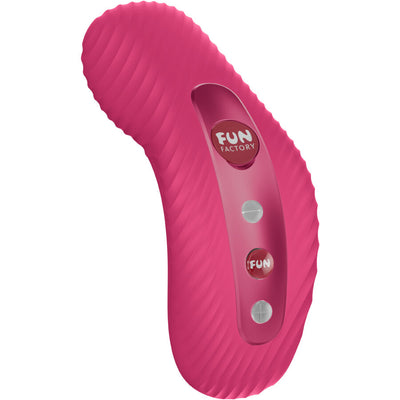
External stimulation poses no problem in a normal pregnancy. A vibrator on the clitoris has no effect on the uterus or the baby. The FUN FACTORY Laya III at €27.99 is a lay-on model, nothing inserted, with pressure controlled entirely by hand — useful when sensitivity varies from one day to the next.
Penetration with an object follows exactly the same rules as penetration generally: permitted if sex is permitted, excluded if it is not. With heightened hygiene requirements, since vaginal flora is more vulnerable during pregnancy — see our cleaning and care guide.
Two things to set aside, however: intense, prolonged cervical stimulation, and suction or vacuum devices applied to the vagina. When in doubt, ask your midwife, who has heard the question before.
Comfort above all
With lubrication becoming unpredictable, a good lubricant becomes a basic rather than an extra. On congested, more sensitive tissue, choose it fragrance-free, glycerin-free and without warming agents: the SWEDE Original Sensitive at €12.99 meets that brief, where the fruit-flavoured ranges do not. Our guide to lubricants covers the families.
If discomfort persists outside sex, an intimate moisturiser at €24.99 acts on the tissue over time, which a lubricant does not.
Perineal massage: the most useful thing here
It is not remotely erotic, and it is the most concrete recommendation in this article.
Practised from around 34 weeks, a few minutes several times a week, perineal massage softens the tissue and reduces the risk of tearing and episiotomy. It is one of the best-documented preventive measures of late pregnancy, and it costs almost nothing.
The technique is taught in an appointment with a midwife — ask, it is expected. It can be done alone or with a partner, after a warm bath, which relaxes the tissue.
As for product, a plain vegetable oil is sufficient. A gentle massage oil at €16.99 also works for the back, legs and late-pregnancy aches, where it will earn its keep further. One caution: not all essential oils are compatible with pregnancy. Check the composition and ask your midwife if in any doubt.
The couple side
Two difficulties recur, and they mirror each other.
On the partner's side, the fear of causing harm or « reaching the baby » is extremely common, rarely voiced, and frequently read as disinterest by the pregnant woman. Reading the first paragraph of this article together settles most of that misunderstanding.
On the pregnant woman's side, the relationship to her own body changes fast, and not always in the expected direction. Feeling desirable in a body that transforms every week sometimes takes time, and it cannot be willed.
In both cases the way out is the same: say it, and accept that intimacy runs through other channels for a while. Our guides to sex without penetration and intimacy after a baby extend the reading on either side of the birth.
Frequently asked questions
Can sex trigger labour?
In a full-term, low-risk pregnancy, no: studies do not show labour being brought on by sex. Contractions felt after orgasm are physiological and pass. With threatened preterm labour, follow medical advice strictly.
Can the baby feel anything?
They perceive movement and the maternal heartbeat, as they would during a walk or a fit of laughter. They understand nothing of the situation and retain no trace of it.
Is light bleeding after sex worrying?
The cervix is more fragile and more vascular during pregnancy, so light bleeding is common and often benign. Report it to your midwife or doctor anyway, every time, and let them judge.
Can I use a vibrator while pregnant?
Externally, yes, without restriction in a normal pregnancy. Internally, the rule is that of penetration generally, with heightened hygiene. Avoid intense cervical stimulation and suction devices.
Why has my desire disappeared completely?
Hormones, fatigue, nausea, anxiety, a changing body: the reasons are numerous and they compound. It is common, usually temporary, and it says nothing about your relationship. Desire generally returns in the second trimester.
Are condoms still relevant?
Yes, outside a tested exclusive relationship. A sexually transmitted infection acquired during pregnancy can have consequences for the baby. See our guide to condoms.
When can we resume after the birth?
The postnatal check, around six weeks, gives the go-ahead. But the real timeline depends on healing, fatigue and desire — and it is often longer than people imagine. Nothing is urgent.
In short
In an uncomplicated pregnancy, sex remains possible from the first day to the last. The baby is not at risk, and contractions after orgasm are normal.
Check that no contraindication applies to you, never blow air into the vagina, avoid lying flat on your back for long after the second trimester, and keep a plain lubricant within reach.
And if desire disappears for a few weeks, that is not a symptom. That is a pregnancy.
Our lubricants and intimate care and massage oils complete this reading.